How to Design and Develop a Successful Jewelry Ecommerce Store
The jewelry industry is changing and having the right ecommerce site is absolutely vital for any jeweler, diamond supplier or jewelry manufacturer who is looking to grow their business online. The platform you choose (Shopify or a custom solution) is going to be very much dependent on your product pricing, your inventory and the markets you're targeting. At Webindia Master we build and design jewelry ecommerce websites that are perfectly tailored to your business and your sales objectives. Explore some of our jewelry ecommerce projects and the key things to consider when building an ecommerce site for your jewelry business.
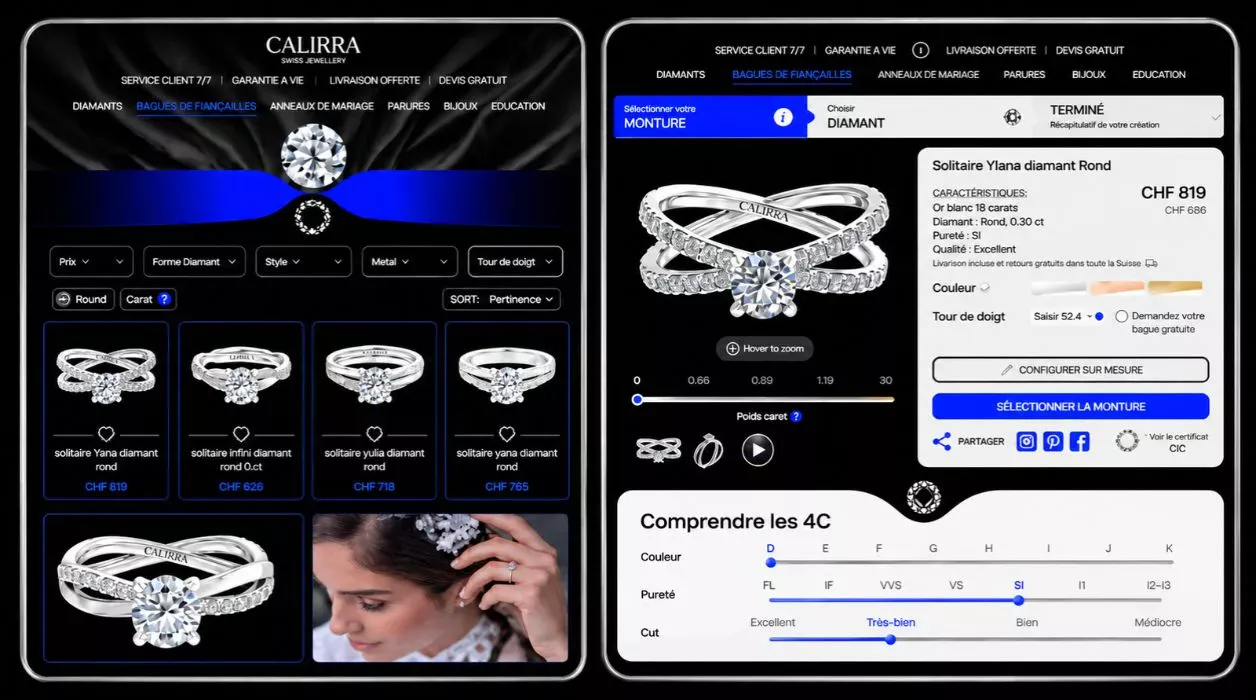
What does a jewelry website design company do?
A jewelry website design company plans, designs and builds online jewelry stores: custom layouts, product photography presentation, filters, secure payments, delivery integrations and SEO. Webindia Master builds these stores for retail jewelers, manufacturers, wholesalers and diamond suppliers in India and 50+ countries, on Shopify, Magento, WooCommerce, Laravel and custom platforms.
For a jewelry business, the website is a showroom that is open 24 hours a day and reaches customers beyond any one city. Since our start, we have delivered over a hundred ecommerce websites across industries worldwide. This guide covers what a jewelry website should include, how it is designed for each type of jewelry business, which technologies it can be built on, how payments and delivery work, and how SEO brings it traffic after launch.

get started with a free SEO audit
Get your website ranking on page 1 with our AI-powered SEO strategies.
Proven results for 850+ clients worldwide.
What makes a jewelry website design convert?
A converting jewelry website combines high-resolution photography, fast mobile pages, clear filters by budget, metal and gemstone, a transparent price breakdown, and visible trust signals such as hallmark and certificate details. Design builds the desire; structure and verification remove the doubt that stops a high-value purchase.
| Design layer | What the customer sees | What it needs behind it |
|---|---|---|
| Visual | Hero imagery, collections, consistent photography | Art direction, retouching standards, WebP delivery |
| Navigation | Categories, occasions, filters, search | Faceted catalogue, search index |
| Product page | Zoom, 360° view, specs, price breakdown | Structured product data, media pipeline |
| Trust | Hallmark, certificate, returns, reviews | Verification links, policy pages |
| Pricing | A clear, current price | Rate-linked pricing where metal prices move |
| Mobile | Swipe galleries, sticky cart | Performance budget, tested on mid-range phones |
| Checkout | Fast, safe payment | Gateways, EMI, fraud screening |
| Delivery | Insured, tracked shipping | Carrier integrations, serviceability checks |
Who is this guide for?
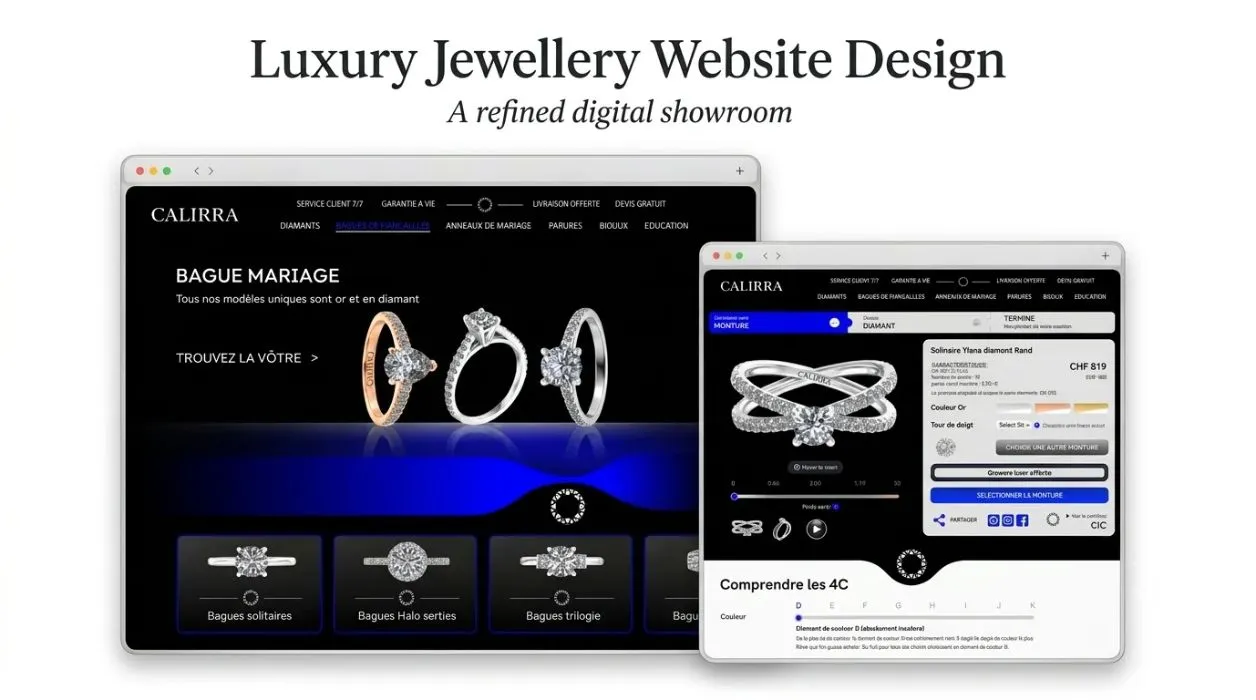
This guide is for retail jewelers, jewelry manufacturers, wholesalers and diamond or loose-stone suppliers planning or rebuilding an online store. Each group has different design priorities and inventory models, which determine the platform, integrations, and budget described below. The sections follow the order a design and build team would work in.
| Business model | Design priority | Key build need |
|---|---|---|
| Retail jeweler | Brand feel, product photography, trust | Rate-linked pricing, certificate display |
| Manufacturer / B2B | Catalogue clarity, quote flow | Wholesale tiers, ERP link |
| Diamond supplier | Search and filter speed | Feed publishing and syndication |
| Fixed-price fashion jewelry | Visual merchandising, speed | Standard catalogue; no rate engine needed |
What features should a jewelry website include?
A professional jewelry website should include a visual storefront, a searchable and filterable catalogue, rich product pages, secure checkout, rate-linked pricing where metals move, customer engagement tools, back-office integrations and marketing tools. The table groups the features a jewelry store typically needs, so you can pick the ones your business requires.
| Feature group | Features |
|---|---|
| Storefront | Custom homepage, collection pages, lookbooks, brand story, responsive layout, multi-language and multi-currency |
| Catalogue and search | Category and occasion navigation, advanced filters, auto-suggest search, product comparison, recently viewed, shop by price |
| Product page | Zoom, 360° view, video, 3D or AR view, specifications, price breakdown, certificate and hallmark display, size guide, ring size finder |
| Personalisation | Engraving, custom and made-to-order requests, ring or jewelry configurator, build-your-own set, gift message and gift wrap |
| Pricing and inventory | Live gold and silver rate pricing, making-charge rules, GST handling, diamond feed sync, stock by location, back-in-stock alerts |
| Cart and checkout | Guest checkout, wallets and UPI, cards, net banking, EMI, bank transfer, coupons, saved addresses, address and pincode validation |
| Trust | SSL, hallmark and certificate verification links, return and exchange policy, reviews, trust badges, authenticity guarantee |
| Engagement | Wishlist, reviews with photos, live chat and chatbot, WhatsApp chat and order updates, video-call shopping, appointment booking, store locator |
| Loyalty and value | Old-gold exchange or buyback, referral and loyalty points, gift cards, monthly instalment or savings plans (confirm regulation with counsel) |
| Marketing | Email and SMS automation, abandoned-cart recovery, price-drop alerts, Google Shopping and social catalogue feeds, blog and guides |
| Back office | Order management, barcode or SKU management, GST invoices, ERP, POS and accounting sync, multi-warehouse inventory, role-based admin |
| Analytics | GA4, Search Console, conversion tracking, heatmaps, funnel reports |
What should you decide before designing a jewelry website?
Decide ten things before design starts: your audience, brand identity, user journey, imagery standard, mobile approach, security and trust signals, SEO plan, social proof, calls to action and analytics. These choices set the layout, platform and budget, and changing them after the build is far more expensive than settling them first.
| Factor | What to decide | Why it matters |
|---|---|---|
| Target audience | Luxury buyers, bridal, fashion-led, gifting, wholesale | Guides layout, tone and price display |
| Brand identity | Logo, palette, typography, visual style, story | Consistent branding builds recognition and trust |
| User experience | Categories, search, checkout steps | Easy discovery and purchase |
| Imagery | Photography standards, zoom, 360°, video | Jewelry is judged visually; images carry the sale |
| Mobile | Responsive layout, touch gallery, fast load | Most browsing happens on phones |
| Security and trust | SSL, secure gateways, badges, policies | Protects data and reassures high-value buyers |
| SEO | Keyword map, URL structure, schema | Organic visibility from day one |
| Social proof | Reviews, ratings, testimonials, social links | Reduces purchase doubt |
| Calls to action | Buy, enquire, book a video call, subscribe | Guides visitors to the next step |
| Analytics | GA4, Search Console, conversion events | Shows what to improve |
How should design differ by type of jewelry business?
Design choices should follow the jewelry type: fine gold and diamond stores need trust and detail, bridal stores need emotion and guidance, fashion jewelry needs speed and variety, and wholesale needs clarity and quotes. The tables below give a baseline for each page, then the changes for each segment.
The segments used in the tables: Fine (gold and diamond), Bridal (engagement and wedding), Lab-grown (lab-created diamonds), Silver (silver and everyday), Fashion (imitation or artificial jewelry), Traditionalr (kundan, polki, temple, meenakari), B2B (wholesale and manufacturer).
How should a jewelry homepage design be finalised?
A jewelry homepage should lead with one strong hero image, three to five collection or category entry points, a visible search box, a bestseller or new-arrival row, and trust signals above the fold. Keep the layout spacious, limit typefaces to two, and make every block link to a product list.
| Homepage block | Purpose | Design notes |
|---|---|---|
| Hero | Set the brand tone and drive one action | One image or short video; one clear button |
| Category entry points | Fast route to rings, earrings, necklaces, bridal | 3–5 tiles; consistent crops |
| Bestsellers / new arrivals | Social proof and discovery | 4–8 products with price visible |
| Trust strip | Reduce doubt early | Hallmark, certification, returns, insured delivery |
| Story or craftsmanship | Support premium pricing | Short; one image and 40–60 words |
| Footer | Policies and contact | Returns, care guide, size guide, contact options |
| Segment | Hero focus | Modules to add |
|---|---|---|
| Fine | One signature piece, macro detail | Craftsmanship story, certificate trust strip, appointment or video call |
| Bridal | Couple or hand-with-ring image | Engagement ring finder, ring size guide, wedding sets, custom design enquiry |
| Lab-grown | Sparkle close-up with clear “lab-grown” label | Natural vs lab-grown explainer, 4Cs guide, price comparison |
| Silver | Lifestyle imagery, everyday wear | Price-led collections, gifting, new arrivals, care tips |
| Fashion | Bold lifestyle banners, offers | Trending now, shop by occasion and price, festive sales |
| Traditional | Festive or bridal-set imagery | Shop by craft, regional collections, occasion edits, store locator |
| B2B | Catalogue range and capability | Login for wholesale pricing, minimum order terms, quote request, bulk download |
What should a jewelry product page include?
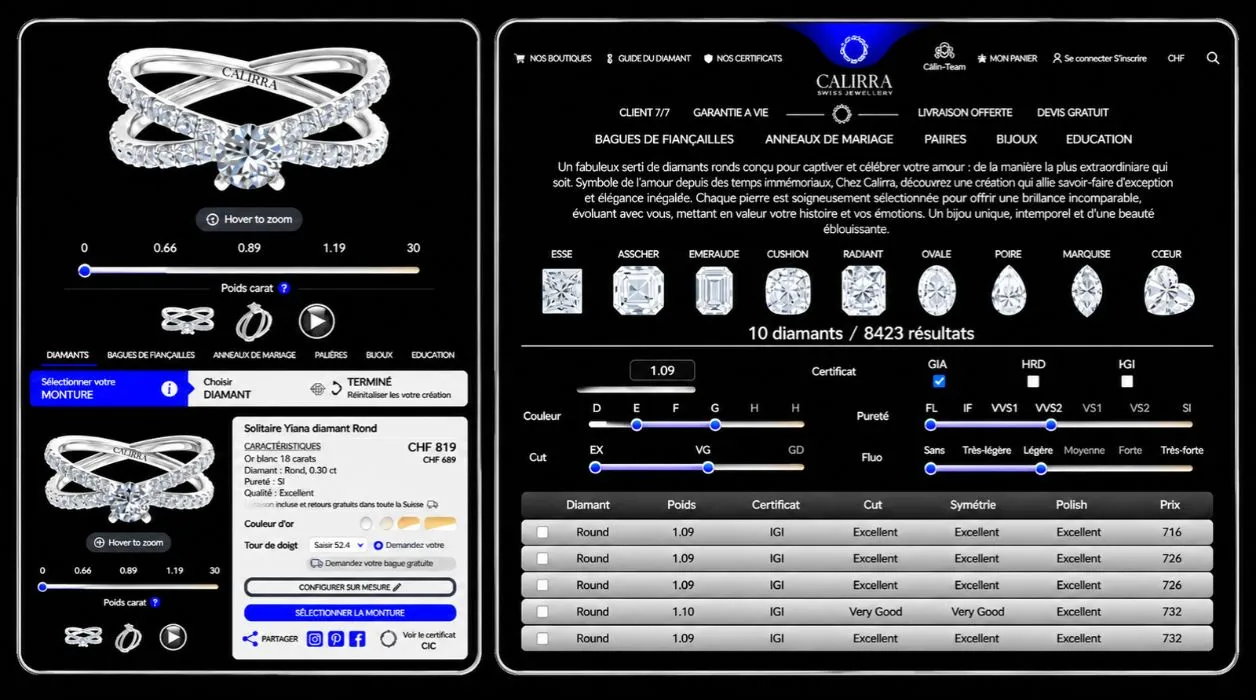
A jewelry product page needs zoomable high-resolution photography, 360-degree or video views, clear metal, purity, weight and stone specifications, a price breakdown, certificate or hallmark details, a size guide and a visible return policy. Together they let shoppers judge quality without holding the piece.
| Product page element | Why it matters | Specification |
|---|---|---|
| Image gallery | Lets shoppers inspect craftsmanship | 5–8 images per product: front, angle, on-model, scale, close-up, packaging |
| Zoom | Shows stone settings and finish | Source images of at least 2,000 px on the long edge, served as WebP |
| 360° view or video | Replaces handling the piece | Spin of 24–36 frames, or a 10–15 second video, for higher-priced items |
| Specifications | Supports comparison and returns | Metal, purity, gross and net weight, stone type, carat, dimensions |
| Price breakdown | Builds trust in the number | Metal, making charge, stone value, tax |
| Certificate and hallmark | Verifiable authenticity | Identifier shown, linked to official lookup |
| Size guide and returns | Reduces pre-purchase doubt | Ring and bangle size charts; return window stated near the button |
| Add to cart, wishlist, enquiry | Supports considered purchases | Sticky on mobile; enquiry option for made-to-order pieces |
| Delivery estimate | Sets expectations | Pincode or country check, insured shipping note |
| Reviews and Q&A | Social proof | Verified-buyer reviews; photo reviews |
| Segment | Must-show details | Extra elements |
|---|---|---|
| Fine | Metal, purity, net weight, stone details, HUID | Making-charge breakdown, certificate link, buyback or exchange terms |
| Bridal | Setting style, centre stone, ring size range | Ring size finder, resizing policy, engraving, “build your ring” |
| Lab-grown | Lab-grown label, carat, colour, clarity, cut, IGI or GIA report | Report link, origin disclosure, natural-vs-lab comparison |
| Silver | Purity (925), weight, finish | Care guide, gift wrap, tarnish policy |
| Fashion | Material, plating, size, occasion | Colour variants, “shop the look”, easy returns |
| Traditional | Craft type, stones, set contents, weight | Matching sets, customisation, lead time for made-to-order |
| B2B | SKU, weight, purity, minimum order quantity | Tiered pricing, bulk add, downloadable images and spec sheet |
For segments that sell lab-grown diamonds, state clearly that the stone is lab-grown; the US FTC Jewelry Guides require this disclosure. Pair the page design with product-focused shoots; see our ecommerce product photography service.
How should navigation and filters work on a jewelry site?
Navigate by how people shop: category (rings, earrings, necklaces), occasion (wedding, gifting), metal, gemstone and budget. Filters should use sliders for price and carat, show live result counts, keep their state in the URL, and work with one hand on mobile. Never hide the filter behind a tiny icon.
| Filter | Control | Notes |
|---|---|---|
| Category and occasion | Top menu and tiles | Match the words shoppers use, such as “engagement rings” |
| Price | Range slider | Show currency; update result count live |
| Metal and purity | Checkboxes | Yellow, white, rose gold; 14K, 18K, 22K |
| Gemstone | Chips | Diamond, ruby, emerald, pearl |
| Sort | Dropdown | Popular, new, price low to high, price high to low |
| Search | Persistent box with suggestions | Handle misspellings and both spellings, jewelry and jewellery |
| Segment | Top navigation | Priority filters |
|---|---|---|
| Fine | Collections, Diamonds, Gold, High jewelry | Metal, purity, stone, price, weight |
| Bridal | Engagement, Wedding bands, Build your ring, Guides | Shape, carat, setting, budget, ring size |
| Lab-grown | Loose diamonds, Rings, Learn | 4Cs, shape, lab, price |
| Silver | Women, Men, Gifts, New | Price, type, occasion, finish |
| Fashion | New, Trending, Sets, Sale | Price, colour, material, occasion |
| Traditional | By craft, By region, Bridal sets, Festive | Craft, stone, weight, occasion, price |
| B2B | Catalogue, Categories, Request quote, Login | Category, weight range, purity, MOQ |
Keep filter state in the URL so results can be shared and bookmarked. Index only the filter combinations with real search demand and point the rest to a canonical page.
How is a jewelry website designed for mobile?
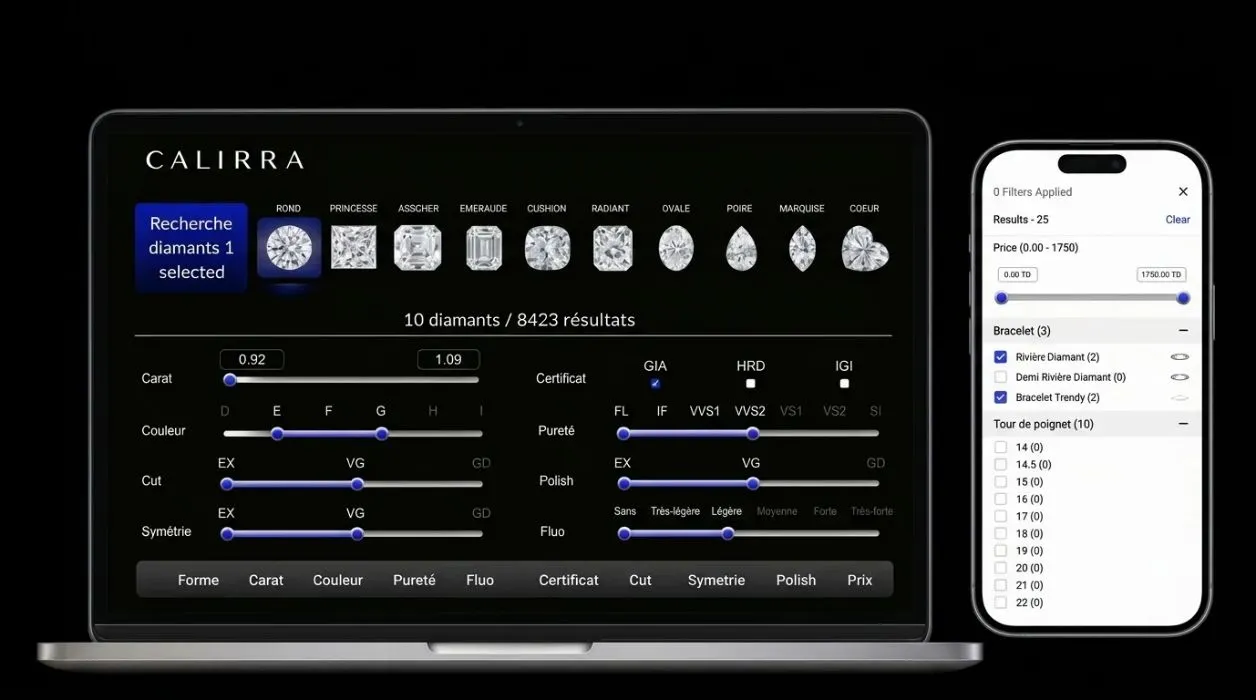
Design the mobile layout first: thumb-reachable filters, swipeable image galleries with pinch-zoom, sticky add-to-cart, and a checkout with wallets and UPI or local payment options. Compress images to WebP and test Core Web Vitals on mid-range phones, because slow galleries lose jewelry shoppers before they see the product.
| Metric | Google’s “good” threshold | Common jewelry-site cause of failure |
|---|---|---|
| Largest Contentful Paint (LCP) | 2.5 seconds or less | Oversized hero image or video |
| Interaction to Next Paint (INP) | 200 milliseconds or less | Heavy gallery and try-on scripts |
| Cumulative Layout Shift (CLS) | 0.1 or less | Images without set dimensions; late-loading banners |
| Segment | Mobile priority |
|---|---|
| Fine | Fast, high-detail zoom; WhatsApp or video-call button; sticky enquiry |
| Bridal | Ring size finder, saved wishlist shared with family, appointment booking |
| Lab-grown | Light filter panel for 4Cs, quick compare |
| Silver | One-tap add to cart, wallet and UPI checkout, gifting flow |
| Fashion | Infinite scroll, short video, social login, quick checkout |
| Traditional | Set-level galleries, WhatsApp enquiry, regional language option |
| B2B | Fast reorder, saved lists, PDF catalogue download |
How do branding, color and typography signal luxury?
Luxury jewelry sites use restrained palettes, generous white space, a serif display font paired with a clean sans-serif, and photography on consistent backgrounds. Consistency across logo, packaging imagery and product shots signals craftsmanship; clutter and discount banners signal the opposite. The right palette and type still depend on the segment.
| Segment | Palette (example hex) | Typography | Imagery and tone |
|---|---|---|---|
| Fine | Ivory #FAF7F2, charcoal #1C1C1C, champagne gold #C9A96E | High-contrast serif display (Playfair Display, Cormorant Garamond) + light sans (Jost) | Dark or neutral backdrops, macro detail, quiet and exclusive |
| Bridal | White #FFFFFF, blush #F4DCD6, rose gold #B76E79 | Refined serif with wide spacing + clean sans (Lato) | Bright, soft, on-model close-ups, romantic |
| Lab-grown | White, cool grey #F3F5F7, ice blue #A9C7E8, black | Modern sans (Inter, DM Sans) with one serif accent | Crisp white studio, transparent about origin, modern |
| Silver | White, slate #2F3A45, silver #BFC5CC | Geometric sans (Poppins, Montserrat) | Clean lifestyle and flat-lay, approachable |
| Fashion | Coral #FF6F61, teal #1F9E9E, mustard #E8B730 on white | Rounded or bold sans | Colourful lifestyle, social-first, playful |
| Traditional | Maroon #7B1E2B, deep green #0F4D3A, antique gold #B8860B, cream #FFF4E0 | Classic serif (Cormorant, Marcellus); support Devanagari where needed | Festive, heritage, detail shots of craft |
| B2B | Navy #12263F, grey, white, gold accent #C9A96E | Neutral sans (Inter, Roboto) | Clean catalogue shots, information first |
Use at most two typefaces, keep the logo, packaging, and product imagery consistent, and test the palette for contrast so text stays readable on every background. Colours above are starting points to adapt to each brand, not fixed values. For identity work, see our logo design and graphic design services.
Which software and technologies can a jewelry website be built on?
A jewelry website can be built on hosted platforms (Shopify, BigCommerce), open-source platforms (Magento, WooCommerce, OpenCart, PrestaShop), custom frameworks (Laravel, CodeIgniter) or a headless setup that pairs a commerce back end with a React or Next.js front end. The right choice depends on pricing logic, catalogue size, budget and the team that will manage the store.
| Platform | Best for | Metal-rate repricing | Large diamond inventory | Configurator |
|---|---|---|---|---|
| Shopify / Shopify Plus | Fast launch, managed hosting, standard catalogue | App or custom function | Possible with external search | Line-item properties, or headless |
| Magento (Adobe Commerce) | Complex catalogue and pricing | Native extensibility | Strong with a search index | Custom module |
| WooCommerce (WordPress) | Smaller catalogues, lower budget, content-led stores | Plugin or custom code | Needs care at scale | Plugin or custom |
| BigCommerce | Mid-size catalogues, multi-channel selling | App or API | Possible with external search | App or headless |
| OpenCart / PrestaShop | Budget builds with local extensions | Extension or custom code | Limited at scale | Custom |
| Custom Laravel / CodeIgniter | Bespoke rules and integrations | Fully custom | Fully custom | Fully custom |
| Headless (Next.js + commerce API) | Premium front end, speed, multi-region | API-driven | Strong with a search service | Fully custom |
Review each row against your catalogue before committing; the right choice depends on SKU counts, feed volume and your internal team. See our Shopify, Magento, Laravel, and WordPress development services.
| Layer | Options |
|---|---|
| Front end | HTML5, CSS3, Tailwind, JavaScript, React, Next.js, Vue or Nuxt |
| 360°, 3D and AR | Image-sequence viewers, WebGL with Three.js, glTF models, Google model-viewer, ARKit and ARCore, try-on vendors such as Perfect Corp or Vyking (evaluate per catalogue) |
| Back end | PHP (Laravel, CodeIgniter), Node.js, Python |
| Database and cache | MySQL, PostgreSQL, Redis |
| Search and filters | Elasticsearch, OpenSearch, Algolia, Typesense |
| Media | Image CDN (Cloudinary or Imgix), WebP and AVIF delivery, video hosting |
| Hosting | Shopify managed, AWS, Google Cloud, Azure, DigitalOcean, Cloudflare CDN and WAF |
| ERP, POS and accounting | Tally, Zoho Inventory and Books, Odoo, SAP Business One, jewelry ERP systems through API or CSV |
| CRM and marketing | HubSpot, Zoho CRM, Salesforce, Klaviyo, Mailchimp, Brevo |
| Chat and support | WhatsApp Business API, Tidio, Intercom, Zendesk |
| Reviews | Judge.me, Yotpo, Trustpilot |
| Analytics | GA4, Google Tag Manager, Search Console, Meta Pixel, Microsoft Clarity, Hotjar |
Which payment gateways suit a jewelry website?
A jewelry store should offer a payment gateway that supports cards, UPI, net banking, wallets and EMI for domestic buyers, and cards, PayPal and buy-now-pay-later for international buyers. High-value orders also need bank transfer, fraud screening and a clear refund process, because card and UPI limits can block large purchases.
| Market | Gateways and methods | Notes |
|---|---|---|
| India | Razorpay, PayU, CCAvenue, Cashfree, PhonePe PG, Paytm PG, Juspay, Easebuzz, BillDesk | UPI, cards, net banking, wallets, EMI. Confirm current UPI per-transaction limits for your category |
| Global | Stripe, PayPal, Adyen, Braintree, Square, Authorize.net, Checkout.com | Cards, Apple Pay, Google Pay, local methods |
| Middle East | Tap, PayTabs, HyperPay, Telr, Checkout.com | Local cards, Mada and regional wallets; check availability per country |
| Buy now, pay later | Affirm, Klarna, Afterpay, Sezzle (US, UK, AU); Tabby, Tamara (Gulf) | Useful for mid and high-ticket pieces |
| EMI (India) | Bank EMI and NBFC partners, such as Bajaj Finserv | Show monthly cost on the product page |
| High-value orders | Bank transfer (NEFT or RTGS), payment links, part payment or booking amount | Add manual confirmation above a set value |
- Security: hosted checkout or tokenisation so card numbers never touch your servers; 3-D Secure and OTP authentication.
- Fraud control: velocity checks, address-mismatch rules, and manual review for very high orders.
- Currency: multi-currency pricing with a clear conversion and tax display.
- Compliance: KYC and PAN-type thresholds vary by jurisdiction.
- Cash on delivery: avoid or cap it for jewelry; it raises return and fraud risk.
How should delivery, insurance and returns be set up?
High-value jewelry needs insured, tracked, signature-on-delivery shipping, often through specialist carriers such as Shiprocket, Brink's, Malca-Amit, Sequel Logistics or BVC, plus general carriers for lower-value items. The store should quote insured rates at checkout, enforce declared-value limits per carrier, and store chain-of-custody events against each order.
| Order value band | Typical approach | Checkout behavior |
|---|---|---|
| Lower value | Standard insured courier | Live rate at checkout |
| Mid to high value | Specialist insured carrier | Quote at checkout; signature required |
| Very high value | Specialist carrier, pre-arranged | Order held for manual confirmation |
| Area | What to set up |
|---|---|
| India carriers and aggregators | Shiprocket, Delhivery, Blue Dart, DTDC, Xpressbees; pincode serviceability and estimated delivery date |
| International carriers | DHL, FedEx, UPS, Aramex; duties and taxes shown at checkout (delivered duty paid or unpaid) |
| Export documents | Commercial invoice, HS code 7113 for jewelry, customs declaration |
| Delivery controls | OTP or signature on delivery, insured declared value, tamper-evident packaging, unboxing-video policy |
| Tracking | Branded tracking page, SMS, email and WhatsApp updates, webhooks from carriers |
| Returns and exchange | Clear window, resizing, exchange and buyback terms; engraved and made-to-order items marked non-returnable |
| Packaging | Branded box, certificate and invoice inside, gift option |
Some carriers offer APIs; others work through a booking desk, so plan for tracking webhooks where available and a manual status workflow where not.
How is a jewelry website kept secure?
A jewelry store handles customer names, addresses, phone numbers and order history for high-value purchases, so this data needs strong protection. We never see or store card details. All payments go through a secure third-party payment gateway, which processes card information on its own protected servers. On our side, the site uses encryption in transit and at rest, a web application firewall, role-based admin access and regular backups. Security also helps sales: visible trust signals reassure shoppers, while slow or insecure pages drive them away.
| Control | Practice |
|---|---|
| Transport | TLS (HTTPS) everywhere with HSTS |
| Payments | Hosted, PCI-DSS compliant payment gateway; card details are entered and processed on the gateway’s secure page and never stored on our servers |
| Application | WAF, rate limiting, regular dependency updates, two-factor authentication for admins |
| Data | Encrypted customer data (names, addresses, contact details, orders), least-privilege access, audit logs |
| Resilience | Daily backups, staging environment, uptime monitoring |
| Privacy | Consent banner and policies aligned with India’s DPDP Act or the GDPR, depending on your markets |
We also provide website maintenance after launch for updates, security and performance.
How does a jewelry website design project run, and how long does it take?
A jewelry website design project runs in six stages: discovery, wireframes, visual design, build with integrations, testing, and launch. A template-based Shopify store typically takes 6–10 weeks; adding custom design and development might take upto 10–14 weeks or more depending on complexities and testing.
- Discovery: catalogue size, pricing model, target markets, competitors.
- Wireframes: homepage, category, product page and checkout flows.
- Visual design: palette, typography, photography direction, component library.
- Build and integrations: theme or custom build, rate engine, feeds, payments, shipping.
- Testing: mobile devices, Core Web Vitals, checkout, price calculations.
- Launch: redirects, analytics, schema, indexing and post-launch monitoring.
| Scope | Indicative timeline |
|---|---|
| Shopify catalogue store | 6–10 weeks |
| Shopify or WooCommerce + rate engine | 10–14 weeks |
| Redesign of an existing jewelry site | 1-1.5 months |
What is the next step after launch: SEO for jewelry websites?
SEO is the step that follows launch and brings organic buyers to the store. For jewelry, it means keyword-mapped category and product pages, unique product copy, Product schema, fast mobile pages, buying guides, local listings and ongoing link building. Plan it before design so URLs, filters and content are search-ready. FAQ rich results are now limited to a small set of sites, so use FAQ markup for machine readability, not as a promised search feature. Contact us to know more!
View all our SEO services
Why work with Webindia Master on a jewelry website?
Webindia Master has delivered over a hundred ecommerce websites and projects in 50+ countries, and offers design, development, photography, SEO and maintenance from one team. Jewelry stores get a build planned around pricing, inventory, trust and delivery, not just a theme.
We serve clients in India, the United States, the United Kingdom, UAE, Australia, Canada, Singapore, Saudi Arabia, France, South Africa and more than 40 other countries.
Talk to our team of Experts
Webindia Master designs and builds jewelry ecommerce stores on Shopify, Magento, WooCommerce, Laravel and custom platforms. Send your catalogue size, pricing model, and target markets for a free design and architecture review. Explore our other ecommerce development services.


 J
 Kuwait