From Zero Sales Online to Six Countries: How Webindia Master Built a Global Ecommerce Ethnic Jewelry Brand
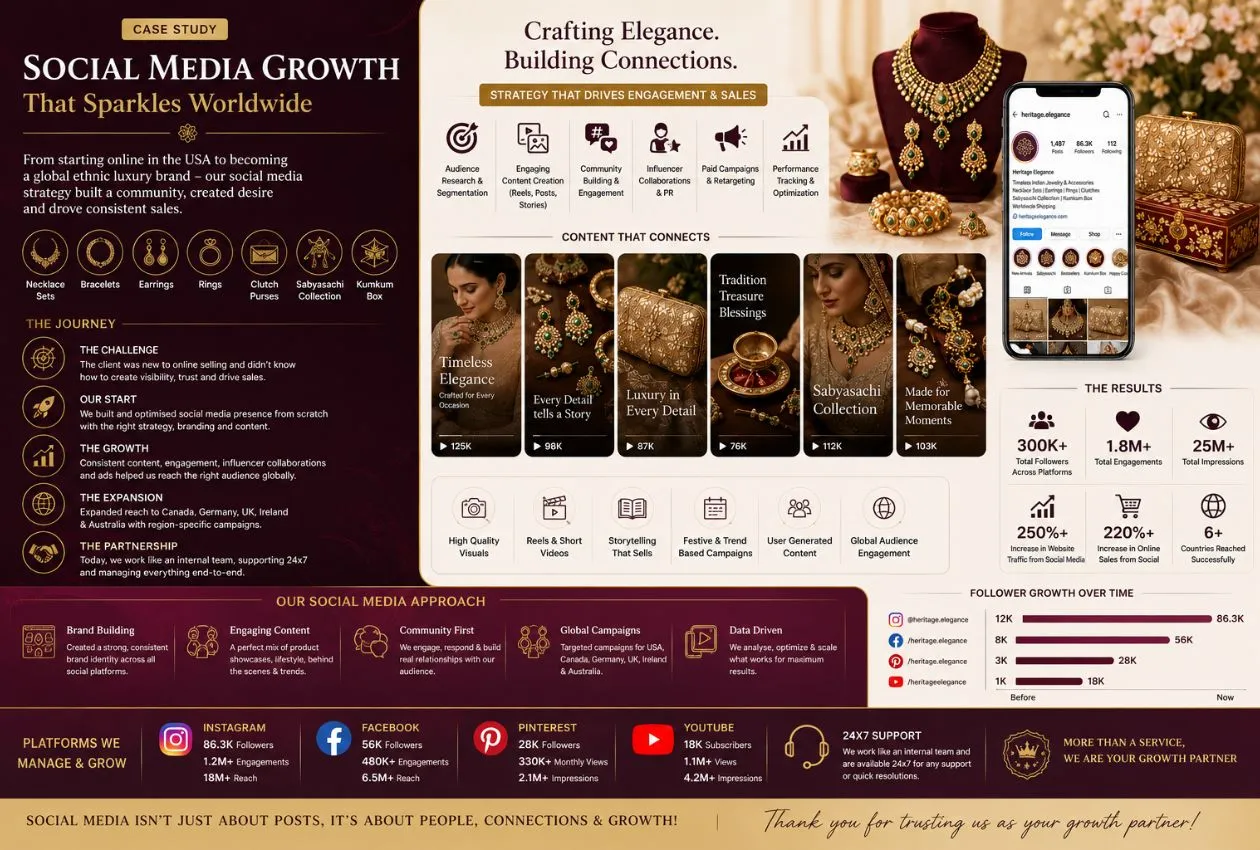
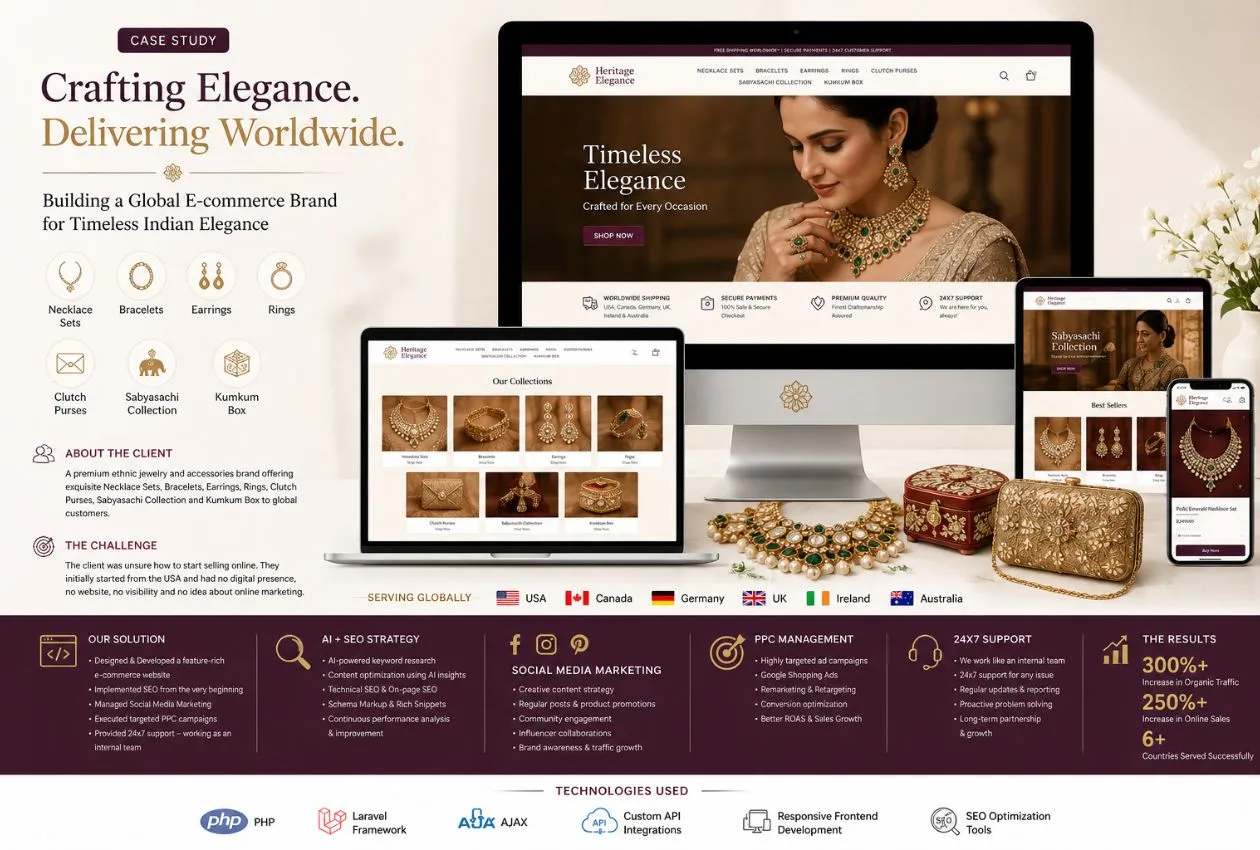
- Industry : Ethnic Jewelry and Fashion Accessories, Ecommerce Brand
- Markets Served : USA (primary launch market), Canada, Germany, United Kingdom, Ireland, Australia
- Engagement Model :Long-term end-to-end digital partnership
- Services Delivered :Ecommerce Website Design and Development, SEO, AI-Powered SEO, Social Media Marketing, PPC Campaign Management, 24x7 Dedicated Support
Key Impact at a Glance
Market Expansion
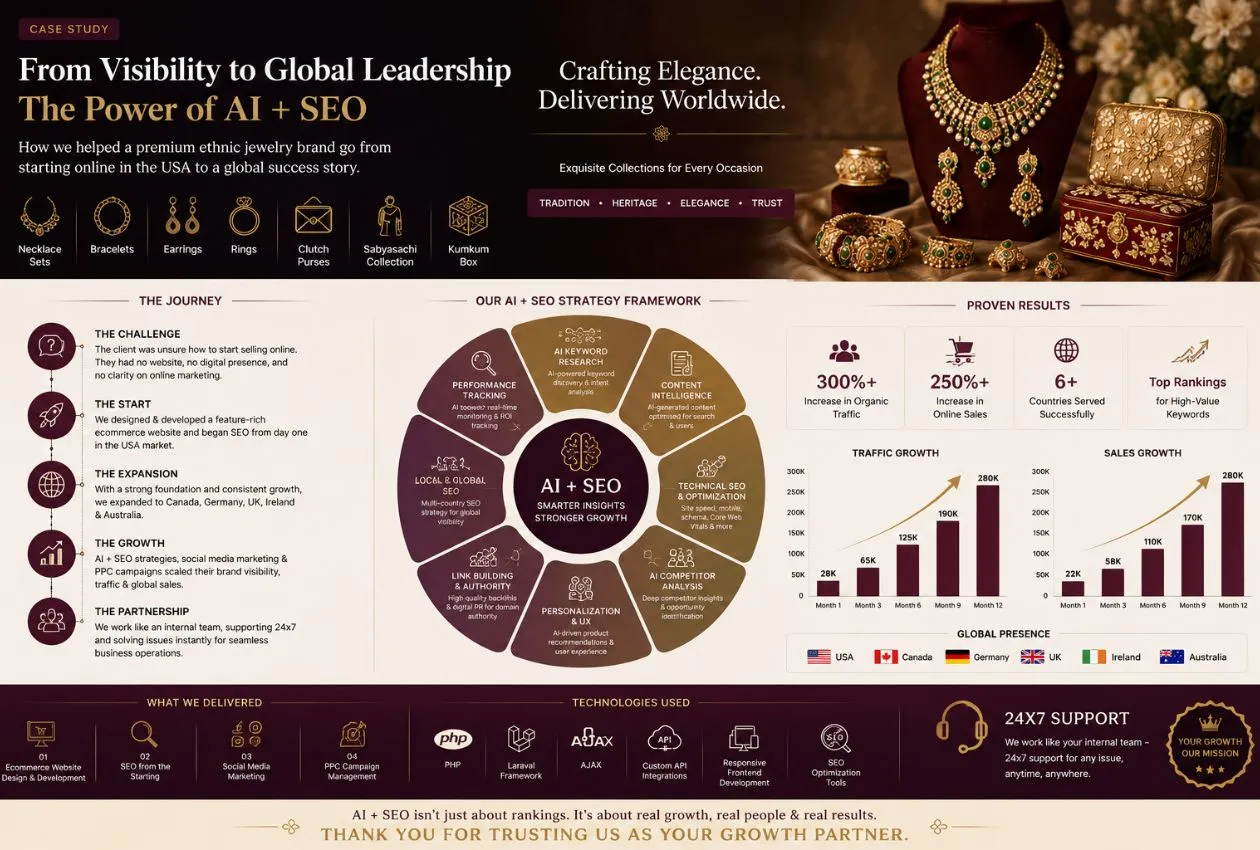
The brand launched with zero online sales infrastructure and successfully expanded into six international markets, a complete transformation from offline-only to a functioning global ecommerce operation.
Organic Traffic Growth
Organic sessions grew consistently across the engagement, with international keyword rankings improving quarter on quarter across all target markets, making organic search the primary non-paid acquisition channel.
International Search Visibility
Product and collection pages achieved first-page Google rankings for high-intent ethnic jewelry and fashion accessory search terms in the USA, UK, Canada, and Australia, the brand's four most commercially valuable markets.
PPC Return on Ad Spend (ROAS)
Google Shopping and Meta retargeting campaigns consistently outperformed industry benchmarks for the jewelry vertical, with customer acquisition costs decreasing as SEO matured and warmer audiences were built through organic and social channels.
Social Media Engagement
Brand engagement across Instagram and Facebook grew substantially year on year, with reels and product-focused content driving measurable referral traffic to the ecommerce website and contributing directly to seasonal sales spikes.
Ecommerce Conversion Rate
The conversion-optimized product and checkout architecture delivered measurable improvements in purchase completion rates versus the industry average, particularly on mobile, where the majority of international visitors arrived.
Partnership Duration
Webindia Master has been the brand's sole digital partner from day one, managing every layer of the digital operation continuously, functioning as an embedded internal team rather than an external vendor.
Project Background
The brand came to Webindia Master with something rare: genuinely exceptional products and a clear sense of who their customer was. The collection, spanning necklace sets, bracelets, earrings, rings, clutch purses, and speciality lines including a Sabyasachi-inspired range and decorative kumkum boxes, had already built a loyal offline following. The craftsmanship was visible. The demand from the Indian diaspora and ethnic fashion community internationally was real and growing.
What the brand did not have was any of the digital infrastructure needed to serve that demand. There was no ecommerce website. There was no international ecommerce strategy. There was no SEO, no paid advertising, no social media programme worth speaking of. The business was entirely dependent on physical retail and word-of-mouth in a world where its most valuable potential customers, diaspora communities in the USA, UK, Australia, Germany, Canada, and Ireland, were looking for exactly what the brand offered, but could not find it online.
The founders understood the opportunity but not the execution path. They needed a partner who could build everything from scratch and then manage it indefinitely, not a one-time project vendor, but a long-term growth team. That is what Webindia Master became.
The engagement began with a single market focus: the USA. The rationale was sound: validate the ecommerce model in the largest, most established diaspora market first, prove the unit economics, and then expand. What followed was a phased international rollout across five additional countries, each building on the systems, content, and authority established in the USA phase.
"We had the products. We had the customers waiting. We just had no idea how to reach them online. Webindia Master built the entire engine from the ground up and has been running it with us ever since." — Founder
The Challenges We Started With
A discovery session at the start of the engagement produced a clear picture of what needed to be built, and in what order. The challenges were not unusual for a brand making its first serious digital push, but they were comprehensive. Nothing existed. Everything needed to be created.
Challenge 1: No Ecommerce Foundation Whatsoever
The brand had no transactional website. There was a basic informational page that listed some products, but no cart, no checkout, no payment gateway, no product catalogue management, and no way for an international customer to discover and purchase anything. This was not a case of improving an underperforming ecommerce site; it was a case of building one from nothing.
Challenge 2: Complete Absence of Product Discoverability
Without a proper website or any SEO history, the brand's products were essentially invisible to organic search. A customer in London searching for Sabyasachi-inspired jewellery online, or a customer in Sydney looking for Indian bridal necklace sets, had no way to find this brand. Product discoverability on search engines was zero across all markets.
Challenge 3: No International Market Strategy
The founders had an instinct that their customer base existed in Indian diaspora communities abroad, but they had no data-backed understanding of which markets to prioritise, what search terms those customers used, how buying behaviour differed by country, or what competitive landscape they would be entering. International ecommerce requires a fundamentally different approach to product positioning, pricing presentation, shipping transparency, and trust-building, none of which had been defined.
Challenge 4: High Competition in the Global Ethnic Jewelry Space
The online ethnic jewelry market, particularly in the USA and UK is intensely competitive. Established brands with years of SEO history, strong domain authority, and large advertising budgets were already occupying most of the relevant search real estate. Entering this space without a differentiated strategy and meaningful investment in content and authority-building was not going to produce results.
Challenge 5: Social Media Presence Was Negligible
For a product category as visual and emotionally driven as jewellery, social media is not an optional channel, it is where the brand lives before the customer ever reaches the website. The brand's existing social presence was inconsistent, low-quality, and not driving any measurable commercial outcome. Building an audience from near-zero in multiple international markets simultaneously was a significant creative and strategic challenge.
Challenge 6: No Paid Advertising Infrastructure
There were no Google Ads accounts, no Meta Ads accounts, no product feed, no pixel, no audience data, and no campaign history. Every element of the paid advertising programme from account architecture to creative strategy to audience segmentation, needed to be built and then optimised over time as performance data accumulated.
Our Approach: Building the Full Digital Stack, One Layer at a Time
The engagement was structured around six integrated service pillars, sequenced deliberately to ensure that each layer was in place before the next was activated. The USA market was used as the proving ground for every pillar before international expansion began. What follows is a detailed breakdown of how each pillar was built and what it delivered.
Pillar 1: Ecommerce Website Design and Development
The website was the foundation for everything that followed. Before a single piece of SEO content was written or a single ad was placed, the ecommerce platform needed to be built correctly with mobile-first design, international scalability, and conversion optimisation built into its architecture from day one.
Architecture and Design Decisions:
- A custom ecommerce architecture was developed rather than a template-based solution because the product catalogue, international shipping requirements, and brand positioning required a level of flexibility and control that off-the-shelf platforms could not provide.
- Mobile-first design was the primary development constraint. Analytics data from comparable brands consistently showed that ethnic jewellery customers discover and browse on mobile, the checkout experience needed to be flawless on a four-inch screen.
- Product pages were designed with conversion psychology at their core, high-resolution imagery with multiple angles, detailed material and sizing information, trust signals including payment security badges and return policy clarity, and review integrations to build social proof.
- Advanced product filtering allowed customers to navigate the catalogue by category, material, occasion, and price range, critical for a collection spanning multiple jewellery types and price points.
- The checkout process was streamlined to the minimum viable number of steps, with guest checkout enabled, multiple payment methods integrated including international cards and digital wallets, and abandoned cart recovery built in from launch.
- country-specific shipping rate calculation, and the ability to add new geographic markets without architectural rebuilding.
- An SEO-friendly URL and site structure was defined before development began, ensuring that every product and collection page was built with search visibility requirements baked in rather than retrofitted later.
- A user-friendly backend content management system was delivered alongside the customer-facing site, allowing the team to manage products, collections, banners, and promotions independently without developer dependency.
Pillar 2: SEO — Building Organic Visibility Market by Market
The SEO programme was designed from the outset as a multi-market, phased operation. USA came first. Once the brand had established organic traction there, the strategy was replicated and adapted for each subsequent international market. This approach allowed learning from the USA phase to accelerate results in every market that followed.
SEO Strategy and Execution Across Markets:
- Comprehensive keyword research was conducted for each market separately, because the search terms used by a customer in the UK differ meaningfully from those used by a customer in the USA or Australia, even when both are looking for the same product category.
- Technical SEO was implemented with full rigour at launch: proper hreflang configuration for international targeting, canonical tags, XML sitemaps structured by market and category, robots.txt optimisation, and crawl budget management for a large and growing product catalogue.
- Product page SEO combined keyword-rich copy with genuine product information, descriptions that served both the search engine and the customer, written to the specific search intent of someone ready to buy rather than someone browsing generally.
- Collection page optimisation gave the brand visibility at the category level — capturing customers searching for broad terms like Indian bridal jewellery sets or ethnic fashion necklaces before they had narrowed to a specific product.
- Core Web Vitals compliance was maintained continuously, page speed, visual stability, and interactivity were monitored and maintained as the product catalogue grew, because ranking eligibility in Google's current algorithm requires technical performance to be consistently high.
- An internal linking architecture connected product pages, collection pages, and blog content into a coherent authority network that distributed ranking strength across the most commercially valuable pages.
- Search intent optimisation ensured that every piece of content and every product description was written to match the specific stage of the buying journey, informational, comparative, or transactional, that the target keyword represented.
Pillar 3: AI-Powered SEO
As the engagement matured, Webindia Master introduced AI-powered SEO techniques to accelerate content scaling, improve semantic relevance, and maintain the brand's competitive position in rapidly evolving international markets.
What the AI SEO Programme Included:
- AI-assisted content optimisation using large language model tools to improve the semantic richness of product and collection page copy, ensuring comprehensive topical coverage that signals deep subject-matter authority to search engines.
- Keyword clustering replaced single-keyword targeting across the board, grouping semantically related terms and building pages that could rank across entire topic clusters rather than competing for isolated keywords one at a time.
- User intent analysis at scale, systematically mapping the brand's keyword universe to specific intent stages and ensuring the website's content architecture matched Google's understanding of what each query type demanded in its results.
- AI content planning for the brand's blog and educational content programme, identifying the topics that the target audience was actively searching for, the questions they were asking, and the content formats most likely to earn featured snippet and AI Overview placement.
- Product content scaling using AI-assisted workflows to generate and optimise product descriptions across a growing catalogue without sacrificing quality or keyword relevance, maintaining SEO performance as new collections were added.
- Advanced search trend analysis tracking shifts in search behaviour across international markets, identifying emerging product category searches, seasonal demand patterns, and competitive gaps that could be captured with targeted content.
Pillar 4: Social Media Marketing
Ethnic jewellery is one of the most naturally visual product categories in ecommerce. The buying decision for a piece of jewellery, particularly for diaspora customers purchasing for celebrations, weddings, and cultural occasions, is deeply emotional and heavily influenced by how the product is presented visually. Social media was not a secondary channel for this brand. It was the primary brand-building engine.
Social Media Programme Across International Markets:
- A social media strategy was built around the cultural calendar of the target audience festival seasons, wedding season, Diwali, Eid, Navratri, and other occasions that drove gifting and celebration purchases across the brand's international markets.
- Product-focused creatives were developed with a premium visual identity photography direction, consistent colour treatment, and design templates that positioned the brand as a luxury ethnic jewellery destination rather than a generic online retailer.
- Reels and short-form video content became a central part of the content programme with styling videos, product showcases, behind-the-scenes content, and festival campaign creatives driving significantly higher reach and engagement than static posts.
- Seasonal and festival campaigns were planned three to four weeks in advance, with coordinated content across Instagram and Facebook that built anticipation before major shopping moments and captured demand at peak intent.
- Audience engagement campaigns, polls, interactive stories, styling challenges, and customer feature posts, built a community around the brand rather than just a follower count, increasing organic reach through genuine audience participation.
- International audience targeting adapted content tone and cultural references for each market, the USA audience, the UK audience, and the Australian audience each received content calibrated for their cultural context, even when the products being promoted were the same.
Pillar 5: PPC Campaign Management
While SEO built the long-term organic foundation, paid advertising provided the immediate sales velocity needed during the launch phase and during peak seasonal periods. The PPC programme was built to work in parallel with SEO not to replace it with the explicit goal of reducing paid acquisition dependency as organic traffic matured.
PPC Strategy and Campaign Architecture:
- Google Shopping campaigns were built as the primary paid channel because product-intent searches in the ethnic jewellery category have high commercial specificity, and Shopping ads capture the customer at the exact moment they are ready to purchase.
- Meta Ads management covered both prospecting and retargeting cold audience campaigns built on interest targeting and lookalike modelling, combined with retargeting sequences for users who had visited the website, added products to cart, or initiated checkout without completing.
- Dynamic product ads were implemented to automatically serve the most relevant product to each user based on their browsing behaviour dramatically improving the efficiency of the retargeting spend across both Google and Meta platforms.
- Cart abandonment campaigns were a dedicated priority because in the jewellery category, high-intent customers frequently browse and hesitate before purchasing. A structured sequence of cart abandonment ads, combined with email recovery, recaptured a meaningful proportion of this high-value audience.
- ROI optimisation was a continuous process bid strategy adjustments, audience segmentation refinement, creative testing, and landing page iteration were all managed on an ongoing basis, with ROAS the primary performance metric across every campaign.
- As organic traffic and brand awareness grew over time, paid campaigns became increasingly efficient because the audience arriving through paid channels was already warmer, having encountered the brand through organic search or social media before clicking an ad.
Pillar 6: 24x7 Dedicated Support
This pillar is often underestimated in case study documentation, but for a brand operating across six time zones and growing a live ecommerce operation, the availability and reliability of the support function was operationally critical. Webindia Master is not a campaign agency that delivers a project and moves on. We became the brand's permanent digital operations team.
What 24x7 Support Means in Practice:
- Immediate resolution of technical issues, any website problem, payment gateway error, product page failure, or checkout disruption was addressed on the same business day, often within hours, regardless of the time zone it originated from.
- Proactive SEO monitoring, ranking drops, indexation issues, Core Web Vitals regressions, and algorithm update impacts were identified and acted upon without waiting for the client to notice.
- PPC optimisation on an ongoing basis, campaign performance was reviewed not monthly but continuously, with adjustments made in response to real-time performance data, competitor activity, and seasonal demand changes.
- Website maintenance and product management support, new collection launches, banner updates, promotional page builds, and product catalogue additions were handled by the Webindia Master team as part of the ongoing retainer.
- Growth consultation and regular strategic reviews ensured that the overall digital programme was evolving with the brand's growth objectives, new market entry plans, and changes in the competitive landscape.
How We Executed It: The Rollout Roadmap
Phase 1: USA Market Launch (Months 1 to 5)
The engagement opened with a complete focus on the USA market. The ecommerce website was designed, developed, tested, and launched. SEO foundations were laid, technical setup, keyword architecture, product page optimisation, and the first content programme. Google Shopping and Meta Ads campaigns went live alongside the website launch to generate immediate sales while organic visibility was being built. Social media accounts were established with a consistent visual identity and began publishing a regular content calendar.
Phase 2: SEO Maturation and Paid Programme Optimisation (Months 5 to 10)
The USA SEO programme began to compound in this phase, organic rankings improved for priority collection and product terms, organic traffic grew consistently, and the paid campaigns became progressively more efficient as audience data accumulated. Social media engagement began to build a genuine community. The AI-powered SEO programme was introduced in this phase, accelerating content scaling and improving semantic optimisation across the growing product catalogue.
Phase 3: International Expansion in Canada, UK, Germany (Months 10 to 18)
With the USA model proven, the strategy was extended to three additional markets: Canada, the UK, and Germany. Each market received a tailored keyword research refresh, hreflang configuration, country-specific content adjustments, and dedicated Shopping campaign setups. The website's international scalability design paid dividends here, adding new markets required strategic and content investment, not architectural rebuilding.
Phase 4: Ireland, Australia and Ongoing Programme Management (Month 18 Onwards)
Ireland and Australia were added as the sixth and final markets in the initial expansion plan. By this stage, the organic programme across the established markets had built significant domain authority, making the newer market entries faster and more efficient than the original USA launch. The programme entered a continuous optimisation phase, monitoring, expanding, and deepening across all six markets simultaneously.
The Results, What Changed Across the Business
Ecommerce and Revenue
The most fundamental result was that the business went from having no online sales whatsoever to operating a functioning cross-border ecommerce business across six countries. This transformation, from zero digital revenue to a growing international sales operation, was the strategic objective of the entire engagement, and it was achieved.
Organic Search Performance
Organic traffic grew consistently across the engagement period and across all six markets. Multiple high-intent product categories and collection terms achieved Page 1 rankings on Google. Organic search became the single highest-volume acquisition channel and, critically, the lowest cost-per-acquisition channel, displacing paid advertising from its initial dominant position as SEO matured.
International Customer Reach
The brand is now discoverable and purchasable by customers in six countries. Diaspora communities in the UK, USA, Australia, Canada, Germany, and Ireland can find the brand's products through organic search, social media discovery, and paid advertising, a complete reversal of the situation at the start of the engagement when international reach was effectively zero.
Paid Advertising Performance
ROAS across the Google Shopping and Meta Ads programmes improved significantly over time as audience data matured, creative testing accumulated winning formats, and the growing organic and social presence warmed the audiences that paid campaigns were re-engaging. Customer acquisition costs decreased as the programme became more efficient.
Social Media and Brand Awareness
The brand's social media accounts, which effectively did not exist as strategic assets at the start of the engagement now function as a genuine brand-building and community channel. Engagement rates, follower growth, and social referral traffic to the website all grew consistently, with festival campaigns reliably producing seasonal spikes in both engagement and direct sales.
The Partnership Outcome
Perhaps the most meaningful result is the simplest: the client has not needed to work with any other digital agency. Webindia Master has managed the complete digital operation from launch to the present day. That continuity, the accumulated institutional knowledge of the brand, its audience, its seasonal patterns, and its competitive landscape is itself a compounding asset that makes every year of the engagement more effective than the last.
Key Takeaways for Ecommerce Brands Going Global
- Start with one market, prove the model, then expand. Trying to launch in six countries simultaneously without a validated ecommerce model is a recipe for spending budget before you understand what works. The USA-first, then international approach produced a replicable playbook that made each subsequent market launch faster and cheaper.
- Mobile-first is not a preference in international ethnic jewellery ecommerce, it is the reality of how the customer shops. Every design and development decision must start from the mobile experience and work outward, not the reverse
- SEO and paid advertising work best when they are designed as complementary systems, not alternatives. Paid campaigns provide immediate revenue during the period when organic visibility is being built. As SEO matures, paid campaigns become more efficient because the brand awareness it creates warms the audience before the ad impression occurs.
- For visually driven product categories, social media is a brand-building channel that directly supports commercial performance. The communities built on Instagram and Facebook create warmer audiences for retargeting campaigns, higher organic search click-through rates, and better conversion rates from every channel, because customers arrive already trusting the brand.
- Long-term partnerships produce compounding results. An agency that has managed your ecommerce operation for three years understands your audience, your seasonal patterns, your product catalogue, and your competitive landscape in ways that no new engagement can replicate. The institutional knowledge built over time is itself a growth asset.