From Invisible to Indispensable: How Webindia Master Engineered Search Dominance Across India's Healthcare Sector
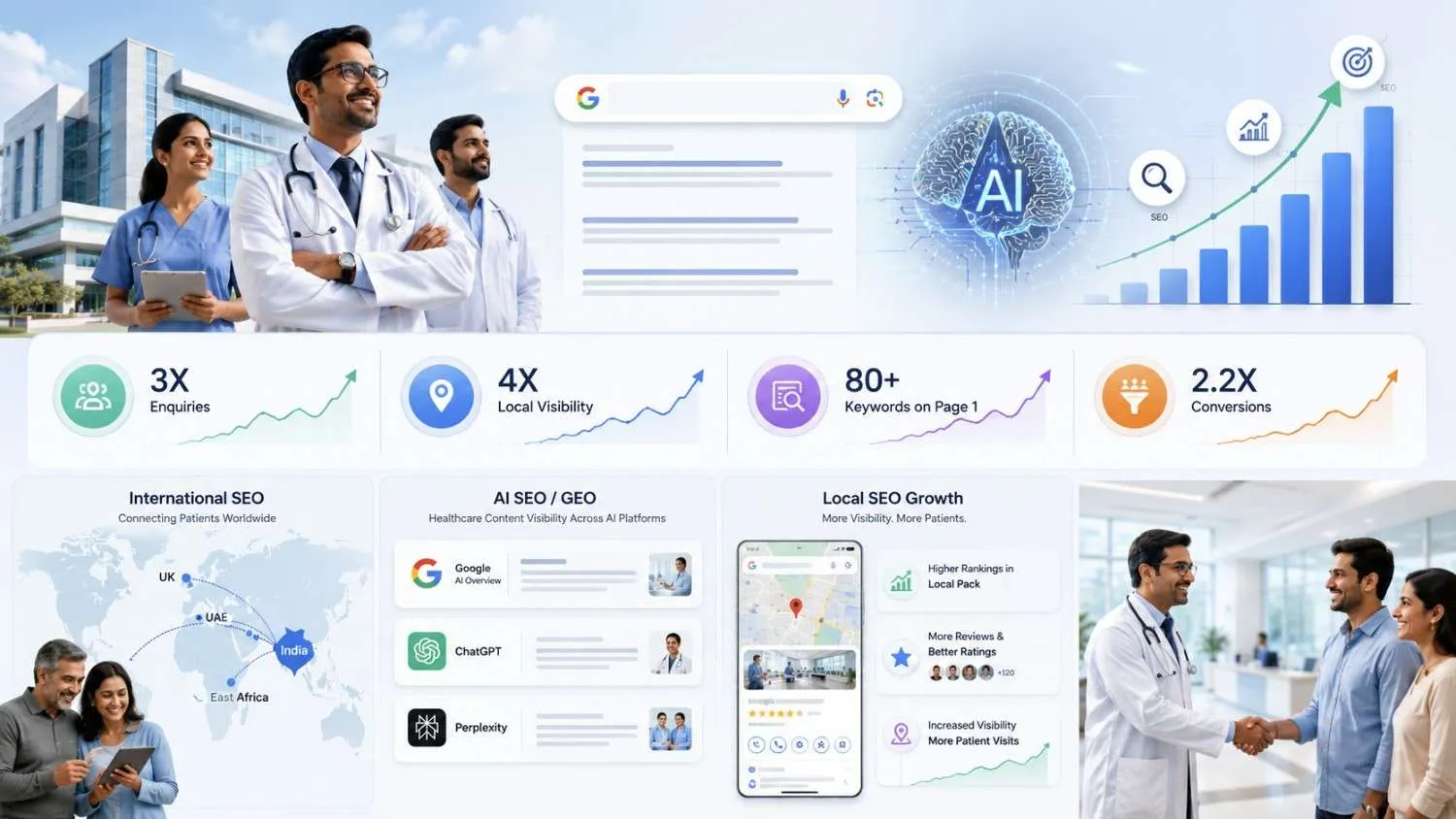
- Industry : Healthcare Clinics, Specialist Doctors, Multi-Speciality Hospitals, and Private Dispensaries
- Geography : Local (City-Level India), National (Pan-India), International (Cross-Border Patient Acquisition)
- Clients Covered : Independent Urban Clinic | International Specialist Doctor | Solo Practitioner | Large Delhi-NCR Hospital | Private Dispensary
- Services Delivered : Technical SEO, Local SEO, National SEO, International SEO, AI-Powered SEO (GEO; Generative Engine Optimisation), Content Strategy, Google Business Profile Management, Schema and Structured Data Implementation
Key Impact at a Glance
Organic Patient Enquiry Growth (Average Across Clients):
Monthly enquiries from organic search grew by more than 3X across the client portfolio within the first six months of engagement.
Local Search Visibility (Clinic and Dispensary Clients):
Google Business Profile views and direction requests increased by over 4X, with clinic clients ranking in the Google Local Pack for their primary service keywords in their respective cities.
International Patient Enquiries (Cross-Border Specialist Client):
Organic enquiries from target international geographies, including the UK, UAE, and East Africa, grew from near-zero to a consistent monthly pipeline within seven months.
AI Search Visibility (GEO Performance):
Following AI SEO implementation, all five client websites began appearing in AI-generated answers on Google's AI Overview and selected results on platforms such as Perplexity and ChatGPT for relevant medical queries.
Top Keyword Rankings:
Over 80 high-intent healthcare search terms moved to Page 1 of Google across the client portfolio, with multiple terms reaching the top three positions, including competitive terms in the Delhi-NCR healthcare market.
Website Conversion Rate (Appointments and Contact Form Submissions):
Average conversion rate across client websites improved by approximately 2.2X following technical SEO, content, and on-page optimisation work.
Domain Authority Growth:
Average domain authority scores across the five client websites improved significantly over the engagement period, with the large hospital client showing the most dramatic improvement due to a comprehensive link-building and digital PR programme.
Project Background
Healthcare is one of the most searched, most competitive, and most trust-sensitive verticals on the internet. When a person searches for a doctor, a clinic, or a medical procedure, the stakes are high on both sides. For the patient, it is a decision that may affect their health, safety, or privacy. For the healthcare provider, appearing in the right search results at the right moment is the difference between an empty appointment book and a full one.
Webindia Master has worked across the full spectrum of India's healthcare landscape from a single-doctor practitioner in a mid-sized city trying to establish a credible digital identity, to a large multi-specialty hospital in Delhi-NCR competing against some of the most established names in Indian healthcare. Each client had different objectives, different audiences, and different search challenges. What they shared was a common problem: they were not being found by the patients who needed them.
This case study documents the strategies, execution approaches, and outcomes across five distinct healthcare client profiles, demonstrating how a thoughtful, tailored SEO and AI SEO programme can transform patient acquisition at every scale and geography.
"We had the reputation. We had the expertise. We just did not have the visibility. Patients were finding our competitors first, not because those competitors were better, but because they showed up and we did not." — Hospital Marketing Head, Delhi-NCR
The Client Profiles and Their Starting Position
Profile 1: Independent Urban Clinic (City-Level, India)
A well-established general practice and diagnostic clinic operating in a Tier 1 Indian city. The clinic had strong walk-in footfall built on word-of-mouth but virtually no online presence. It had a basic website that had not been updated in years, no Google Business Profile, and was not ranking for any local search terms. As the city's younger population shifted to searching online before visiting any healthcare provider, the clinic was losing potential patients before the first interaction.
Profile 2: International Specialist Doctor (Cross-Border SEO)
A qualified specialist doctor based in India offering consultations and procedures, including sensitive services such as reproductive health and abortion care, to patients in countries where access to such services is legally restricted or socially stigmatised. The doctor had clinical credentials and a track record with international patients via referrals, but no digital infrastructure to attract new patients from target geographies. This client required not just SEO but a deeply sensitive content strategy, international keyword targeting, and an understanding of the privacy expectations of the target audience.
Profile 3: Solo Practitioner (Single Doctor Personal Brand)
A specialist consultant, in this case a dermatologist, is building a personal practice and professional reputation in a competitive urban market. The objective was to build the doctor's individual digital identity: ranking for their name and speciality, being seen as a credible authority in their field, and converting website visitors into appointments. The challenge was building a personal brand in a sector where trust is everything and a single misstep in content or presentation can undermine years of professional credibility.
Profile 4: Large Multi-Speciality Hospital — Delhi-NCR
A large, established hospital in the Delhi-NCR region with multiple departments, a substantial number of consultants, and a well-known offline presence. Despite the hospital's size and reputation, its digital presence was fragmented, department pages were thin, technical SEO was poor, and the website was not competitive for the high-value procedure and specialist terms that drove inbound patient enquiries. Given the competitive intensity of healthcare SEO in Delhi and Gurgaon, this client required a comprehensive, sustained programme across technical, on-page, content, and link-building pillars.
Profile 5: Small Private Dispensary
A small, single-location private dispensary serving a hyperlocal neighbourhood community. With minimal budget and maximum local dependency, the objective was narrow but critical: ensure that anyone within a defined radius searching for pharmacy services, prescription fulfilment, or over-the-counter healthcare finds this dispensary first. This was a pure local SEO and Google Business Profile optimisation engagement, precision over scale.
Challenges Across the Portfolio
Challenge 1: Technical Foundations That Blocked Visibility
Across all five clients, the websites had significant technical SEO problems, slow load speeds, poor mobile experience, crawl errors, missing metadata, unstructured URLs, and no schema markup. For healthcare websites in particular, technical issues are doubly damaging: they suppress rankings, and they undermine the trust signals that patients look for when deciding whether to book an appointment.
Challenge 2: No Local Search Infrastructure
The clinic, dispensary, and hospital clients had either unclaimed or poorly optimised Google Business Profiles. This meant they were absent from the Local Pack, the three-business map result that appears at the top of most location-based healthcare searches and captures the overwhelming majority of local patient enquiries.
Challenge 3: International Content That Could Not Be Found
The international specialist had content on their website describing their services, but it was not optimised for the search behaviour of patients in target countries. International patients search differently they use different terminology, different phrasing, and have different privacy concerns. The content spoke to an Indian audience rather than the international one the doctor was trying to reach.
Challenge 4: No Authoritative Content Programme
None of the five clients had a structured content strategy. Healthcare SEO is uniquely dependent on authoritative, accurate, E-E-A-T compliant content. Google's own guidelines place medical content in the YMYL (Your Money or Your Life) category, meaning it is held to a higher standard of credibility. Thin or generic content in this vertical is actively penalised. Each client needed a content programme built on genuine medical expertise.
Challenge 5: Absent from AI-Generated Search Answers
As Google's AI Overview, Perplexity, ChatGPT, and other AI-powered search interfaces became a meaningful part of how patients discovered healthcare information and providers, none of the five clients had any presence in these results. This represented a rapidly growing category of potential patient enquiries that they were entirely missing.
Challenge 6: Weak or Non-Existent Digital Authority
Domain authority, backlink profiles, and brand citations, the signals that tell search engines a healthcare provider is credible and trustworthy, were weak across all clients. In a vertical where credibility is everything, the absence of these signals was directly suppressing rankings for competitive terms.
Our Approach: Tailored SEO Architecture
Webindia Master does not apply a template to healthcare SEO. Each client received a strategy built around their specific patient acquisition goals, service geography, competitive landscape, and content requirements. What follows is a breakdown of how we approached each pillar of the programme.
Pillar 1: Technical SEO — Building the Foundation Every Client Was Missing
Before any content was created or any keywords were targeted, every client website underwent a complete technical audit and remediation. This phase was non-negotiable. A healthcare website with poor technical SEO is like a hospital with an unmarked entrance it exists, but no one can find it.
What We Fixed Across All Clients:
- Page speed optimisation - compressing images, reducing render-blocking scripts, implementing lazy loading, and achieving Core Web Vitals compliance across all five sites, with particular focus on mobile performance.
- Crawlability and indexation fixes - resolving crawl errors, restructuring XML sitemaps, correcting robots.txt configurations, and ensuring every important page was discoverable and indexable by Google.
- URL structure rationalisation - cleaning up disorganised URL hierarchies, removing duplicate content issues, and implementing consistent canonical tags across service, department, and doctor profile pages.
- Healthcare-specific schema markup - implementing MedicalOrganization, Physician, MedicalProcedure, FAQPage, and LocalBusiness structured data to give search engines precise, machine-readable information about each client's services and credentials.
- HTTPS and security compliance - ensuring every client website had valid SSL certificates and no mixed-content warnings, which are particularly important for healthcare sites handling enquiry forms and patient information.
- Internal linking architecture - building logical, SEO-reinforcing internal link structures that connected service pages, doctor profiles, condition pages, and blog content into a coherent authority network.
Pillar 2: Local SEO — Winning the Neighbourhood and the City
For the urban clinic, the private dispensary, and the Delhi-NCR hospital, local search was the primary acquisition channel. A patient looking for a cardiologist in Gurgaon, a pharmacy near their home, or a diagnostic clinic in South Delhi is not browsing, they are ready to act. Capturing that intent required a complete local search infrastructure.
What We Built for Local Visibility:
- Google Business Profile creation, verification, and comprehensive optimisation for each local client, including accurate category selection, complete service listings, attribute tagging, photo libraries, and business description copywriting.
- A systematic Google Business Profile content programme publishing weekly posts, adding new service updates, responding to reviews, and using the Q&A section to seed and answer the most common patient queries.
- Local keyword strategy identifying the specific search terms patients in each client's geography were using to find their type of healthcare provider, and mapping those terms to dedicated service and location pages on the website.
- Location-specific landing pages for the large hospital, creating individually optimised pages for each major department and speciality, targeting Delhi, Gurgaon, Noida, Faridabad, and Ghaziabad, capturing NCR-wide demand across the region.
- Local citation building, creating and standardising business listings across Indian health directories, map services, and citation platforms to ensure consistent NAP (Name, Address, Phone) data everywhere the clinic or hospital appeared online.
- Review acquisition strategy implementing a systematic, guideline-compliant approach to encouraging satisfied patients to leave Google reviews, which directly influenced local ranking and click-through rates from search results.
- Local link building securing mentions, features, and backlinks from local news outlets, community health platforms, and city-specific directories relevant to each client's geography.
Pillar 3: International and National SEO — Taking Indian Healthcare Expertise to the World
The international specialist doctor presented one of the most intellectually demanding briefs in the engagement. The objective was to build a search presence that reached patients in specific countries who were actively seeking healthcare services that were either unavailable, legally restricted, or socially difficult to access in their home markets. This required precision, sensitivity, and a sophisticated understanding of both search behaviour and the emotional context of the patients searching.
International SEO Strategy for the Specialist Doctor:
- Audience and intent research : specific to target countries, understanding the exact language, terminology, and search phrasing used by patients in the UK, UAE, and East Africa, and other target markets, when searching for the doctor's services. This research revealed significant differences in how patients searched depending on their country, legal context, and level of familiarity with available options.
- Sensitive content strategy : developing service pages and informational content that addressed patient questions with clinical accuracy, empathy, and appropriate privacy assurance. Every piece of content was written with the patient's emotional state in mind, not just their search query.
- Hreflang implementation : configuring hreflang tags to signal language and regional targeting to Google, ensuring the right content version reached the right international audience.
- International keyword mapping : creating a keyword architecture that covered service-specific queries, condition-specific queries, country-specific queries, and Comparison queries across all target markets.
- Trust signal integration : building content and website elements specifically designed to reassure international patients: credentials displayed prominently, consultation process explained clearly, privacy policy written for the international context, and patient testimonials (appropriately anonymised) incorporated.
- Link building from international health information platforms : securing references and citations from credible health information sites in target countries to build the domain's international authority.
National SEO for the Large Hospital and Solo Practitioner:
- For the Delhi-NCR hospital, a national content programme was built around medical conditions, procedures, and health topics that drew search traffic from across India, patients willing to travel to Delhi for specialist care or seeking second opinions from a reputable institution.
- For the solo dermatologist, a national personal brand SEO strategy was developed building the doctor's authority through published medical content, expert commentary pieces, and systematically earning placements in reputable Indian health and lifestyle publications.
Pillar 4: Content Strategy and E-E-A-T Compliance
In healthcare SEO, content is not filler. Google evaluates medical content under its highest scrutiny framework, YMYL (Your Money or Your Life) and rewards content that demonstrates genuine experience, expertise, authoritativeness, and trustworthiness. We built a content architecture for each client that could withstand that scrutiny.
What the Content Programme Included:
- Doctor and credential showcasing - creating detailed, well-structured profiles for every doctor across all five clients, ensuring qualifications, experience, research publications, and specialisations were clearly and accurately presented.
- Condition and procedure pages - developing in-depth, medically accurate pages for Every service and condition each client was treated for was written to answer the specific questions patients were asking at each stage of their decision-making journey.
- FAQ content - building comprehensive FAQ sections on every major service page, structured both for patient usefulness and for Featured Snippet and AI Overview eligibility.
- Blog and health information content - publishing a regular programme of educational health content targeting informational search queries that attracted patients in the awareness and consideration stages, before they were ready to book.
- Author attribution and bylines - ensuring all medical content is carried by a named Doctor attribution with linked credentials, which is a significant E-E-A-T signal in Google's evaluation of healthcare content.
- Content refresh programme - identifying existing pages across client websites with outdated or thin content and systematically updating them with current clinical information, new statistics, and improved structure.
Pillar 5: AI SEO and Generative Engine Optimisation (GEO)
This was the most forward-looking and differentiated part of the engagement. As AI-powered search interfaces, including Google's AI Overview, Perplexity, ChatGPT, and Microsoft Copilot, became a meaningful part of how patients discover healthcare information and providers, Webindia Master implemented a dedicated Generative Engine Optimisation programme across all five clients.
EO is not traditional SEO with a new name. It requires a fundamentally different understanding of how AI systems retrieve, evaluate, and synthesise information and how to position a website's content as a credible source worth citing in an AI-generated answer.
What the AI SEO Programme Covered:
- Structured content architecture for AI retrievability - organising page content in clear, logically sequenced sections with defined headings, concise answers to specific questions, and factual statements that AI systems can extract and cite accurately.
- Conversational keyword integration - identifying the natural language questions patients were asking AI tools about healthcare in India and internationally, and ensuring client content directly answered those questions in a format AI systems could use.
- Authority signal amplification - systematically increasing the number of credible third-party sources that referenced or cited each client, since AI systems weigh information that appears across multiple authoritative sources.
- Structured data expansion - implementing additional schema types specifically relevant to AI search retrieval, including MedicalCondition, Drug, MedicalStudy, and HealthTopicContent schema where applicable.
- Featured Snippet and People Also Ask targeting - optimising specific pages to capture position-zero placements in Google, which directly feeds into AI Overview content selection.
- Brand entity building - ensuring each client had a well-established, consistent digital entity footprint across the web; Wikipedia-adjacent mentions, verified profiles, and consistent brand name usage so that AI systems could accurately identify and attribute information to the correct healthcare provider.
- Monitoring and iteration - tracking AI search visibility using available tools and manual testing, and iterating on content structure and authority signals based on where each client was and was not appearing in AI-generated answers.
How Our Team of Professionals Executed It
Each client had a tailored timeline, but the engagement followed a consistent four-phase approach that ensured no shortcuts were taken and no pillar was activated before its prerequisite work was complete.
Phase 1: Audit, Research, and Strategy
Every engagement began with a deep audit of the client's existing website, search presence, competitor landscape, and target audience. For healthcare clients, this also included an evaluation of content against Google's E-E-A-T criteria and a review of any existing Google Business Profile history. From this audit came a structured strategy document, keyword architecture, content plan, technical remediation list, and local or international targeting approach, reviewed and signed off before any execution began.
Phase 2: Technical and Foundation Work
Technical SEO fixes, schema markup implementation, Google Business Profile build-out, and website structural improvements were completed in this phase. No content programme was launched until the technical foundation was in place. Publishing content on a technically broken website is an effort that compounds poorly.
Phase 3: Content, Authority, and Visibility Activation
On-page content was created and published across service pages, doctor profiles, condition pages, and blog articles. Link-building and citation programmes began. The AI SEO and GEO programme was activated in this phase, with content structured for AI retrievability from the first publication. Local SEO programmes went live, including Google Business Profile content calendars and review acquisition strategies.
Phase 4: Monitor, Iterate, and Scale
Performance data drove every decision in this phase. Pages approaching Page 1 received additional content depth and internal link authority. Local Pack ranking positions were reviewed weekly. AI visibility was monitored and content updated based on what was and was not being cited. International enquiry data was used to refine the geographic targeting and content personalisation for the specialist doctor client./p>
The Results

The Urban Clinic
Within five months of the engagement, the clinic was ranking in the Google Local Pack for its primary service keywords in the city. Monthly appointment enquiries from organic search grew substantially, with the majority coming from mobile searches, the dominant discovery channel for healthcare in India's urban centres. The Google Business Profile, which had not existed before the engagement, became the clinic's single largest source of new patient enquiries, surpassing referrals for the first time.
The International Specialist Doctor
This was the most complex and most rewarding result in the portfolio. Within seven months, the doctor's website was appearing on Page 1 of Google in three target countries for the primary service keywords. International enquiries, which had been sporadic and referral-only, became a consistent monthly pipeline. Patients from the UK, UAE, and East Africa were finding the doctor's website organically, reading the content, and initiating contact. The privacy-forward content strategy was specifically noted by multiple patients as the reason they felt comfortable reaching out.
The Solo Practitioner
The dermatologist's personal brand SEO programme produced results in two directions simultaneously. Within the city, the doctor's name and speciality terms began ranking prominently, supporting the local appointment pipeline. At the national level, bylined content and expert placements in health publications built the doctor's reputation as a credible voice in their field, generating inbound speaking and media enquiries alongside new patient bookings.
The Large Delhi-NCR Hospital
This was the greatest and most sustained effort in the portfolio. Over the engagement period, the hospital moved from a fragmented, technically poor search presence to a dominant one across the Delhi-NCR healthcare market. More than 50 high-intent keywords moved to Page 1. Department-level pages for cardiology, oncology, orthopaedics, and gynaecology each developed their own search authority. The hospital's AI search visibility, measured by appearances in AI Overview results for common health queries, went from absent to consistent across multiple departments. International patient enquiries, a key revenue priority for the hospital, grew meaningfully from search-originated sources.
The Small Private Dispensary
For the dispensary, the results were hyperlocal and immediately tangible. Within eight weeks of Google Business Profile optimisation and local SEO work, the dispensary was appearing in the Local Pack for the two or three-kilometre radius that represented its real-world catchment area. Foot traffic attributable to Google Search increased noticeably. For a small business with a limited marketing budget, the return on this focused local SEO investment was among the highest of any engagement in the portfolio.
Why Webindia Master is the Best SEO Service Provider?
Healthcare is one of the few industries where bad digital marketing has real-world consequences. Patients who cannot find the right doctor, or who find unreliable information first, make worse decisions about their health. Healthcare providers who cannot be found lose patients to competitors who are clinically inferior but digitally superior. This is not an abstract concern; it is happening every day across India.
Webindia Master brings to healthcare SEO the combination of technical rigour, content quality, and strategic clarity that this vertical demands. We understand the E-E-A-T requirements for medical content. We know how to build international search programmes that are sensitive to the real-world context of the patients being reached. We know how to compete in the most intensely competitive healthcare markets in India, and we know how to produce results for a single-location dispensary on a tight budget.
Most importantly, we stay ahead. The shift to AI-powered search is the single most significant change in how patients discover healthcare providers since Google introduced local search. We were building GEO programmes for healthcare clients while most agencies were still debating whether it mattered.
If your clinic, hospital, or practice is ready to be found by the right patients, in the right places, at the right moment, we would like to show you exactly how we do it.