From Scattered Traffic to Scalable Revenue: How Webindia Master Rebuilt an Indian Ecommerce Brand's Complete Digital Presence

- Industry : Ecommerce & Retail
- Geography : Pan-India
- Engagement Duration : Approximately 9 Months
- Services Delivered : Website Design & Development, Custom Dashboard Development, SEO, Social Media Management
Key Impact at a Glance
Organic Traffic Growth
Grew by more than 3X within six months of the new website going live.
Bounce Rate
Dropped by approximately half, indicating a significantly improved on-site experience.
Conversion Rate
Increased by around 2.5X, driven by a cleaner purchase journey and stronger trust signals.
Social Media Engagement
Grew over 4X from the baseline across Instagram and Facebook.
Page Load Speed
Improved by over 60%, with Core Web Vitals scores moving from failing to compliant.
Search Rankings
Multiple high-commercial-intent product category keywords moved to Page 1 on Google, with several reaching the top three positions.
Reporting Efficiency
Weekly data reporting time was reduced significantly after the centralised dashboard replaced five separate manual tracking tools.
Project Background
The client is a growth-stage Indian ecommerce company selling consumer goods across multiple product categories through their own website and select marketplaces in India. They had been operating for several years with an established offline reputation and genuine product-market fit.
However, their digital presence was fragmented, underperforming, and not contributing to revenue in any meaningful way.
When they approached Webindia Master, the core problem was not a lack of ambition; it was a lack of system. The brand had invested in various digital activities over the years, but without a unified strategy or the right technical foundation, none of it had compounded into real growth. The website was outdated. SEO had never been done properly. Social media was inconsistent. And there was no way to measure what was actually working.
The engagement was structured as a comprehensive digital transformation, not a collection of standalone services. The goal was to build an integrated, self-reinforcing growth engine that the brand could operate and scale with confidence.
"We did not want another agency to run a few ads and send a monthly PDF. We needed someone to think like a co-founder and rebuild from the ground up." — Business Owner
Challenges We Inherited
A thorough audit conducted at the start of the engagement revealed six interconnected problems. Each one was serious on its own. Together, they were compounding the brand's stagnation.
Challenge 1: An Outdated, Underperforming Website
The existing website had been built on a legacy setup with no mobile optimisation. Navigation was confusing, the checkout flow had too many steps and too little trust, and product pages lacked the structure or content needed to convert visitors into buyers. On mobile, where most of the brand's potential customers were arriving, the experience was particularly poor.
Challenge 2: No SEO Foundation
The domain had minimal authority, no structured keyword targeting, missing or duplicate metadata across hundreds of pages, and no content programme of any kind. The brand was essentially invisible on Google for every search term that mattered commercially. Organic traffic was contributing almost nothing to revenue.
Challenge 3: No Centralised Performance Visibility
There was no single place to see what was happening across the business digitally. Traffic data, sales data, social data, and campaign data all lived in separate tools and spreadsheets. Decisions were made on intuition rather than evidence. This made it impossible to move quickly or confidently on anything.
Challenge 4: Inconsistent, Low-Impact Social Media
The brand had accounts on Instagram, Facebook, and YouTube, but posting was irregular and the content had no clear voice, strategy, or objective. Engagement was very low. Social media was creating no measurable impact on brand awareness, website traffic, or sales.
Challenge 5: High Customer Acquisition Cost
Without organic or social channels contributing to growth, all acquisitions were coming through paid advertising with poor targeting and no retargeting infrastructure. The cost of acquiring each customer was high, and there were no systems in place to improve retention or repeat purchase rates.
Challenge 6: Brand Identity Inconsistency
The visual language of the brand was inconsistent across platforms. Customers encountered a different-looking brand depending on where they found it. This eroded trust and reduced the effectiveness of every marketing rupee spent.
Our Approach: Four Pillars, One Unified Strategy
Webindia Master structured the engagement around four interconnected service pillars. Rather than treating each as a standalone project, we designed them to work as a system with each pillar supporting and amplifying the others. The website provides the destination. SEO brings the right people to it. Social media builds the trust that makes them ready to buy. The dashboard tells us what is working so we can do more of it.
Pillar 1: Website Design and Development
The first and most fundamental priority was to rebuild the brand's website from scratch. Not a cosmetic refresh; a complete structural rebuild designed to perform for the specific way Indian ecommerce customers browse and buy.
What We Designed and Built:
- A mobile-first architecture built around the reality that the overwhelming majority of the brand's audience was arriving via smartphone. Every design decision was made for the smaller screen first.
- New product listing and detail page templates are structured to support the customer's decision-making process with clear photography, concise specification layouts, visible pricing, and prominent calls to action.
- A streamlined checkout flow that reduced unnecessary steps and added trust signals, including review widgets, return policy callouts, and secure payment indicators.
- A WhatsApp support integration and live chat widget to capture hesitant buyers who had questions before committing to a purchase.
- Full Core Web Vitals compliance achieved meaningful improvements in loading speed, visual stability, and interactivity scores, which directly improved both user experience and search engine ranking eligibility.
- A content management system that allowed the brand's team to independently update banners, manage product listings, publish blog content, and run offers without depending on developers for every change.
- Structured data markup across product, breadcrumb, and organisation schema types, giving the website better eligibility for rich results in Google Search.
Pillar 2: Custom Dashboard Development
One of the most impactful parts of this engagement was something that many brands overlook entirely: building the infrastructure to see clearly. Before the dashboard, the founding team had no reliable, unified view of their business performance. After it, they had everything they needed to make confident, fast decisions.
What the Dashboard Delivers:
- A unified traffic and conversion view drawing from GA4 and the ecommerce backend showing sessions, channel breakdown, funnel progression, and where drop-off was occurring.
- Live sales and revenue tracking broken down by product category, individual SKU, geography, and time period with comparisons to previous periods built in.
- An SEO performance module showing keyword rankings, impressions, clicks, and week-over-week position movement for all tracked terms.
- A social media performance aggregator pulling reach, engagement rates, follower growth, and top-performing content from all active platforms into a single view.
- A customer acquisition cost tracker segmented by channel showing the true cost of each customer from organic search, social, paid advertising, and direct for the first time.
- An inventory and order fulfilment status integration surfacing operational bottlenecks before they affect customer experience.
- Automated weekly summary reports are sent to the leadership team, removing the need for manual data collection and freeing up significant time.
"The dashboard became the single most-used tool in the business within 30 days of launch. For the first time, we could walk into any conversation knowing exactly what was working and what was not." — Business Owner
Pillar 3: Search Engine Optimisation
With the technical foundation in place through the new website, we built a structured, long-term SEO programme designed to capture high-intent search demand across the brand's core product categories. The goal was not just traffic; it was the right traffic at the right moment in the buying journey.
SEO Strategy and Execution:
- A comprehensive keyword research process identifying over 300 commercial and informational search terms across all product categories, mapped to specific pages on the website.
- A full on-page SEO audit and remediation covering title tags, meta descriptions, header structure, internal linking, image alt text, and canonical tags across every page of the site.
- Technical SEO work, including crawl budget optimisation, XML sitemap restructuring, robots.txt cleanup, and resolution of redirect chains and 404 errors that were undermining indexation.
- Category page copywriting targeting transactional search queries with content that was genuinely useful to shoppers while being structured for search engines.
- A content programme covering product guides, comparison articles, and how-to content to capture customers at earlier stages of the buying journey before they are ready to purchase.
- A link-building programme targeting relevant Indian ecommerce, lifestyle, and consumer publications to build domain authority over time.
- Google Business Profile optimisation and local SEO work to capture location-based intent in key geographies.
- Monthly ranking reviews with proactive content updates on pages that were ranking in positions 4 to 10 and within reach of Page 1.
By the close of the engagement, organic search had become the brand's fastest-growing and lowest-cost acquisition channel, a complete reversal from the situation at the start.
Pillar 4: Social Media Management
Social media was rebuilt not as a broadcast channel but as a brand-building and community engine. The objective was to make the brand feel consistent, trustworthy, and worth following and to turn that attention into measurable website traffic and purchase intent.
What We Built Across Platforms:
- Instagram: A cohesive visual identity system with a disciplined mix of reels, carousels, and story formats. Content focused on product education, authentic use cases, and customer stories rather than generic promotional material.
- Facebook: A community-focused content strategy built around product information, seasonal campaigns, and retargeting-ready audience development.
- YouTube: Product demonstration videos, behind-the-scenes brand content, and how-to guides optimised for both search and social discovery.
- A 30-day rolling content calendar covering every platform ensuring consistent posting at scale without sacrificing quality or relevance.
- Identification and collaboration with micro-influencers in relevant Indian lifestyle and home categories whose audiences matched the brand's customer profile.
- Social commerce integration product tagging on Instagram and Facebook to reduce the number of steps between discovery and purchase.
- Monthly performance reviews with content strategy adjustments based on which formats were driving actual traffic and conversion, not just likes.
How We Executed It: Phase-by-Phase
The engagement was structured across four sequential phases, each building on the last. This sequencing was deliberate; we did not launch any pillar before its foundation was stable.
Phase 1: Discovery and Strategy (Weeks 1 to 3)
We began with a deep audit of every existing digital asset on the website, social accounts, any prior SEO activity, analytics data, and competitor landscape. From this, we developed a unified strategy document covering audience personas, keyword priorities, content direction, and technical requirements. Nothing moved to execution until the strategy was agreed and signed off on by both teams.
Phase 2: Build — Website and Dashboard (Weeks 4 to 12)
The new website was designed and developed in parallel with the dashboard. Website work moved through wireframes, then the design system, then development, then thorough testing before launch. Dashboard work involved architecture decisions, data source integrations, and custom module development. Both went live by the end of this phase.
Phase 3: Growth Activation — SEO and Social (Months 4 to 6)
With the new website live, on-page SEO implementation began immediately across all pages. The content programme launched with the first set of categories and blog articles. Social media calendars went live across all platforms. Link-building outreach commenced. Performance was tracked weekly against agreed KPIs with bi-weekly check-ins.
Phase 4: Optimise and Scale (Months 7 to 8)
The final phase was driven entirely by data from the dashboard. We doubled down on content formats with the strongest engagement, prioritised SEO pages showing the fastest ranking movement, and refined dashboard modules based on how the team was actually using them day to day. This phase transformed initial results into sustained momentum.
The Results
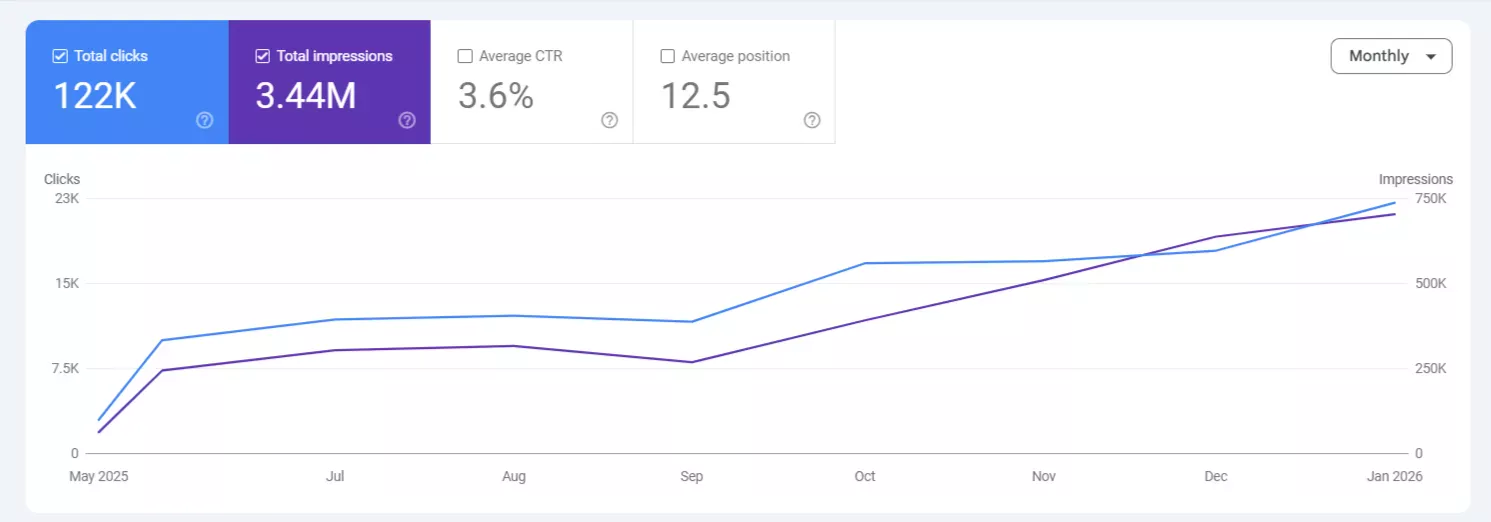
By the close of the seven-month engagement, the brand had undergone a measurable transformation across every digital channel. The following outcomes were achieved:
Website
Bounce rate dropped by approximately half following the relaunch. Session duration increased meaningfully. Mobile users th,e dominant segment saw the most significant improvement in experience, with checkout completion rates improving substantially.
Organic Search and SEO
Organic sessions grew by more than 3X within six months of the new site going live. Multiple category and product pages moved onto Page 1 of Google for high-commercial-intent queries, with several reaching the top three positions. Organic traffic went from contributing almost nothing to being the single largest acquisition channel by volume.
Social Media
Engagement rates across Instagram and Facebook grew by over 4X from the baseline. Consistent content drove measurable increases in profile visits, saves, and website click-throughs directly attributed to social referral. The brand's social accounts began functioning as a genuine discovery and trust-building channel for the first time.
Dashboard and Decision-Making
The custom dashboard replaced five separate manual reporting tools. Time spent on weekly reporting dropped significantly. The speed and quality of business decisions improved the founding team could for the first time act on evidence rather than assumptions within hours rather than weeks.
Business Outcome
Organic search and social media, which had contributed almost zero revenue before the engagement, became the top two acquisition channels by the end of Month 8, ahead of paid advertising for the first time in the brand's history. Customer acquisition cost from digital dropped meaningfully, improving unit economics across the board. The brand entered its next growth phase with a scalable, measurable, and owned digital infrastructure.
Key Takeaways for Indian Ecommerce Brands
This engagement reinforced several principles that are especially relevant for growth-stage ecommerce businesses in India:
- A fast, mobile-first website is the foundation for everything else. No SEO, no social strategy, and no paid campaign can overcome a poor mobile experience, where most Indian ecommerce customers are.
- Data visibility must come before serious scaling. Without a clear, centralised view of what is working and what is not, marketing investment is largely guesswork. A well-built dashboard pays for itself within weeks.
- SEO compounds over time, but only when it is built correctly from the start. Technical integrity, on-page quality, and consistent content creation together create an acquisition engine that grows without proportional cost increases.
- Social media in India is an intent-shaping channel, not just a branding tool. Brands that post consistently with genuine product education and authentic storytelling see measurable traffic and conversion impact, not just follower counts.
- Integration is what creates disproportionate returns. When website, SEO, social media, and analytics work together under one strategy, each channel reinforces the others. Treating them as separate activities is the most common reason digital investment underperforms.
Why Webindia Master for your Ecommerce Brand?
Webindia Master is a full-service digital agency built to help Indian brands grow with clarity and intention. We do not outsource work, we do not operate in silos, and we do not measure success by activity. We measure it by what changes in your business.
Our model is built for brands that want one accountable partner rather than four separate vendors with four separate agendas. From the first wireframe to the hundredth piece of SEO content, every deliverable is owned by a team that understands the bigger picture and is working toward the same outcome.
We work across website design and development, custom dashboard and analytics infrastructure, search engine optimisation, and social media management as integrated services, not standalone products.
If your ecommerce brand is ready to move from fragmented digital activity to a scalable, data-driven growth engine, we would like to speak with you.